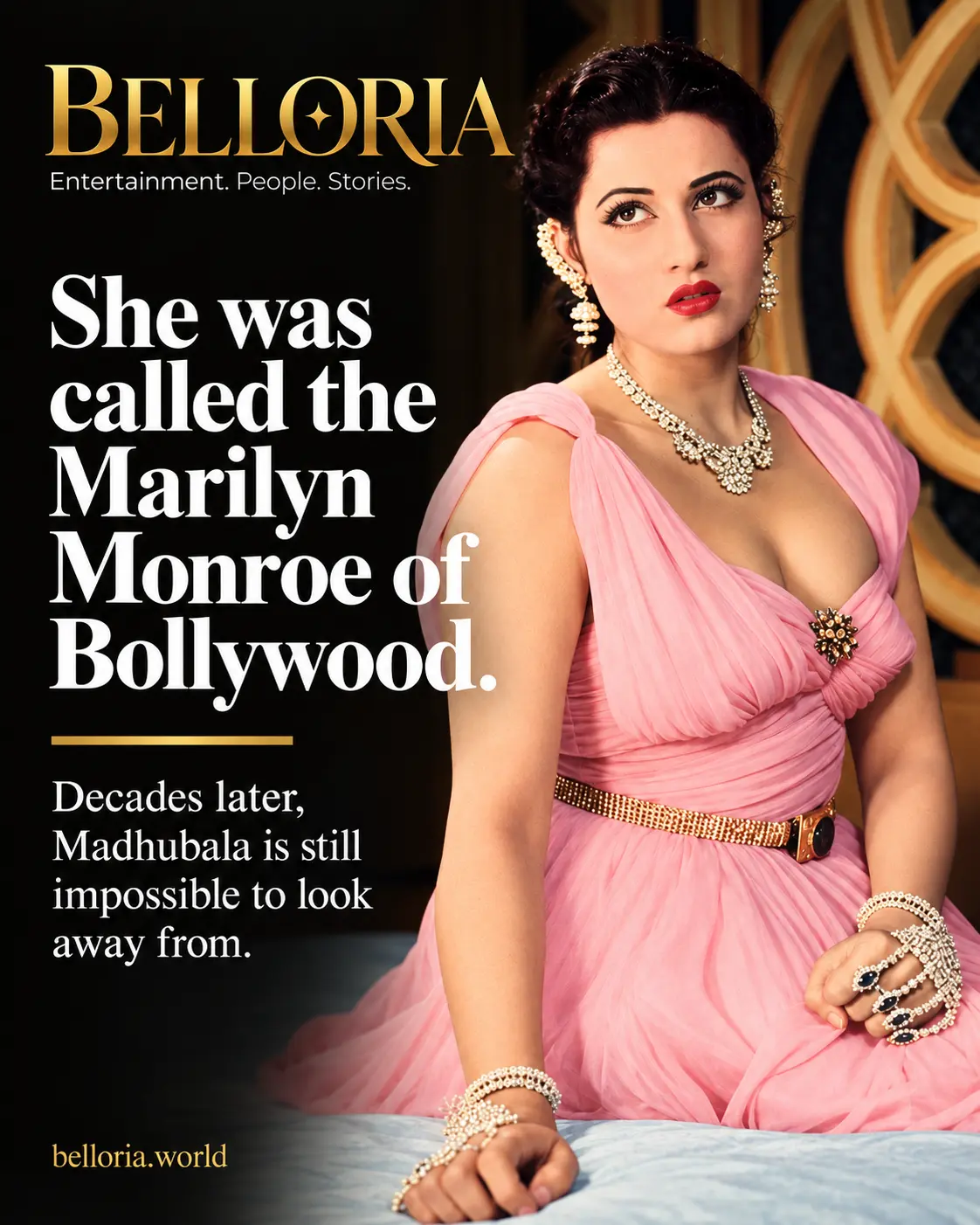
Some stars fade with time. Madhubala never has. More than five decades after her death, her face from Mughal-e-Azam still circulates on social media, her name still tops “most beautiful actress” lists, and her love story with Dilip Kumar is still argued over by people who weren’t alive to witness it. This is the story of Mumtaz Jehan Begum Dehlavi, the girl from Delhi who became Madhubala, and why she has never really left.
Quick Facts
| Real Name | Mumtaz Jehan Begum Dehlavi |
| Known As | Madhubala, “Venus of Indian Cinema” |
| Born | 14 February 1933, Delhi, British India |
| Died | 23 February 1969 (aged 36), Bombay, Maharashtra, India |
| Cause of Death | Ventricular septal defect (congenital heart condition) |
| Occupation | Actress, Producer |
| Years Active | 1942–1964 |
| Spouse | Kishore Kumar (m. 1960) |
| Children | None |
| Notable Recognition | Commemorative postage stamp (2008), Google Doodle (2019) |
Who Is Madhubala?
Madhubala was one of the defining actresses of Hindi cinema’s Golden Age, active through the 1940s, 50s and early 60s. Known for her beauty as much as her range across drama, romance and comedy, she is often described internationally as “the Marilyn Monroe of Bollywood,” a comparison that extends beyond looks to a life that also ended young and became the subject of endless public fascination. She appeared in around 70 films across a two-decade career and remains one of the most recognized faces in Indian film history, largely on the strength of her performance as Anarkali in Mughal-e-Azam (1960). So captivating was her beauty that it shaped her entire public identity, inspiring the iconic nickname “Venus of the Indian screen.”
Early Life and Background
Madhubala was born Mumtaz Jehan Begum Dehlavi in Delhi on 14 February 1933, the fifth of eleven children born to Ataullah Khan and Begum Ayeesha. Her Pashtun Muslim family struggled financially after her father lost his job at the Imperial Tobacco Company in Peshawar, and they relocated to Bombay, settling in a neighbourhood close to the Bombay Talkies film studio.
She entered films as a child, credited as “Baby Mumtaz,” making her debut in Basant (1942) at age nine. She quickly became her family’s primary breadwinner. It was during the making of Neel Kamal (1947), her first lead role at fourteen, that Bombay Talkies co-founder Devika Rani suggested she adopt the screen name “Madhubala,” meaning “honey belle.”
Career
Madhubala’s breakout came with the supernatural drama Mahal (1949), a box office hit that established her as a leading star. Through the early 1950s she took on a wide range of roles, from Badal and Tarana (both 1951) to Sangdil (1952) and Amar (1954), several of them opposite Dilip Kumar. A run of box office setbacks in the mid-1950s, including films made under her own production house, Madhubala Private Ltd., briefly saw her labelled “box office poison” by the industry.
She reversed that with a string of hits from 1955 onward, particularly in comedy, a genre considered risky for leading actresses at the time. Mr. & Mrs. ’55 (1955), opposite Guru Dutt, and Chalti Ka Naam Gaadi (1958), opposite Kishore Kumar, showed a lighter, more playful side that audiences responded to strongly.
Major Work and Notable Projects
Between 1958 and 1960, at the peak of her career, Madhubala delivered some of the biggest hits of Hindi cinema’s Golden Age.
| Film | Year | Notable For |
|---|---|---|
| Mahal | 1949 | Breakout hit, established her as a leading star |
| Mr. & Mrs. ’55 | 1955 | Career-reviving comedy with Guru Dutt |
| Chalti Ka Naam Gaadi | 1958 | Hit comedy opposite Kishore Kumar |
| Howrah Bridge / Kala Pani | 1958 | Back-to-back crime thrillers |
| Mughal-e-Azam | 1960 | Her most iconic role, as Anarkali; highest-grossing Indian film at the time |
| Barsaat Ki Raat | 1960 | One of the decade’s biggest musical hits |
Her performance as Anarkali in Mughal-e-Azam brought her widespread critical acclaim and her only Filmfare Award nomination for Best Actress. It is still regarded by critics as one of the finest performances in Indian cinema history. She made her final screen appearance in Sharabi (1964); her last completed film, Jwala, was released in 1971, two years after her death.
Current Projects and Latest Updates
Madhubala’s presence in the culture has never really gone quiet. Her 86th birth anniversary in 2019 was marked with a Google Doodle depicting her as Anarkali, and she appeared on an Indian government commemorative postage stamp in 2008. The New York Times included her in its “Overlooked” obituary series honouring notable women whose deaths were not adequately covered at the time, the only Indian name on that particular list.
A long-discussed biopic of her life remains in development. Her youngest sister, Madhur Bhushan, has spoken publicly for years about wanting Madhubala’s full story told on screen, and has positioned her production company, Madhubala Ventures Private Limited, as a co-producer on any authorized project, stating firmly that any film about her sister requires the family’s permission.
Personal Life
Madhubala’s personal life was dominated by two relationships that have both become part of Hindi film folklore.
Her romance with Dilip Kumar began on the set of Tarana (1951) and lasted around seven years, during which the two co-starred in four films together, including Mughal-e-Azam. The relationship ended during the making of B.R. Chopra’s Naya Daur (1957), when her father objected to an outdoor shooting schedule that would have placed her with Dilip Kumar in Madhya Pradesh. Chopra sued her for breach of contract, and Dilip Kumar testified against her and her father in court, a decision that effectively ended their relationship. According to her sister Madhur Bhushan, Madhubala later told Dilip Kumar she would still marry him if he apologised to her father; he refused, and the two parted for good. She is said to have loved him for the rest of her life.
She married actor-singer Kishore Kumar in 1960, shortly before travelling to London for treatment of a worsening heart condition. Doctors in London confirmed she had a congenital condition, ventricular septal defect, first identified around 1954, and gave her roughly two years to live. The marriage was troubled from early on: accounts from her family describe Kishore Kumar as largely absent during her final years, visiting only occasionally while she lived in seclusion at a house on Mumbai’s Carter Road, cared for by a nurse. Kishore Kumar’s brother, actor Ashok Kumar, offered a more sympathetic account, saying her illness made her bad-tempered and that she often returned to her father’s house during this period. Both accounts agree the marriage was unhappy, though Kishore Kumar reportedly continued to cover her medical expenses. The couple remained married, without divorcing, until her death in 1969.
Madhubala had no children. She died at her family home in Bandra on 23 February 1969, nine days after her 36th birthday, and is buried at the Juhu Muslim Cemetery in Santa Cruz, Mumbai. Her youngest sister, Madhur Bhushan, has remained the family’s public voice on her legacy in the decades since.
Why Is Madhubala Still So Relevant Today?
Part of it is simply the work. Mughal-e-Azam remains a fixture of Indian cinema’s canon, regularly re-released, restored, and colourised for new generations, and Madhubala’s Anarkali is still the reference point for the role. Part of it is the image: her photographs continue to circulate widely online, decades after her death, in a way few of her contemporaries’ do.
But much of her lasting hold on the public imagination comes from the unresolved nature of her personal story. A love that never got its ending, a marriage that never got explained, and an illness that cut short a career still on the rise, together read less like history and more like an open question, one each new generation discovers and tries to answer for itself. The fact that a family-backed biopic has been in the works for years, discussed and delayed and discussed again, is itself a sign that the story still feels unfinished to the people closest to it.
Frequently Asked Questions
How did Madhubala pass away?
She died on 23 February 1969 from complications of ventricular septal defect, a congenital hole in the heart that doctors in that era had no way to treat. She was 36.
Why did Madhubala have no children?
Her heart condition made pregnancy medically risky, and by the time she married in 1960 her health had already begun to decline. She and Kishore Kumar had no children together.
What happened between Madhubala and Dilip Kumar? Why didn’t they marry?
Their seven-year relationship ended after a public court case tied to the film Naya Daur, in which Dilip Kumar testified against her and her father. She later said she would marry him if he apologised to her father; he refused, and they never married.
Why did Kishore Kumar leave Madhubala?
He didn’t formally leave the marriage, but accounts from her family describe him as largely absent during her final years, visiting only every few months while she lived separately with a nurse. Her brother-in-law, Ashok Kumar, offered a gentler version, saying her illness made the relationship difficult for both of them. They remained married until her death.
What were Madhubala’s last words?
There is no reliably documented account of her final words. A frequently shared line, “Main wehem nahin hoon, haqeeqat hoon” (“I am not an illusion, I am reality”), is often mistaken for something she said in real life, but it is actually a line spoken by her character in the film Mahal (1949).
How many husbands did Madhubala have?
One. She married actor-singer Kishore Kumar in 1960, and remained married to him until her death in 1969.
Where is Madhubala’s family now?
Her youngest sister, Madhur Bhushan, is the family’s most public representative and has spoken extensively about Madhubala’s life over the years. She has also been involved in developing an authorized biopic through her production company.